Djamaâ El-Djazaïr Hosts National Forum on Its Role in the Age of Artificial Intelligence
Algiers hosts national forum on AI's role in religious institutions - explores how faith adapts to artificial intelligence.
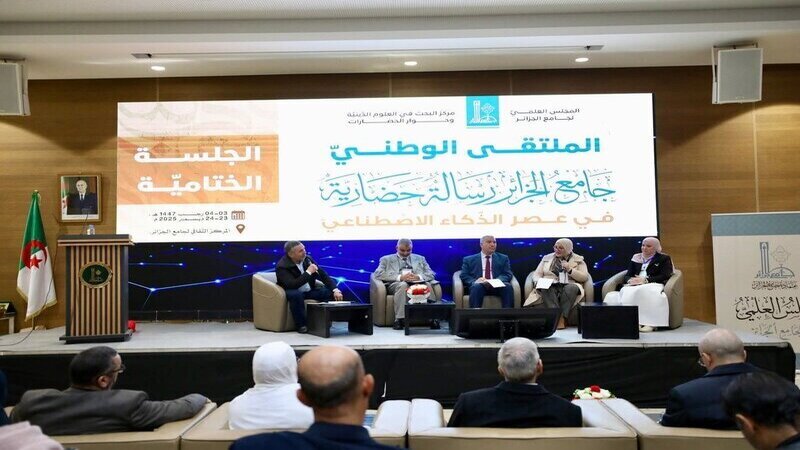
Algiers, December 2025. Djamaâ El-Djazaïr hosted a national forum on the role of religious institutions in the age of Artificial Intelligence, held on 23-24 December 2025 under the patronage of Sheikh Mohamed Mamoune El-Kacimi El-Hoceini, Imam-Rector of Djamaâ El-Djazaïr. The forum was organized by the Research Center for Religious Sciences and the Dialogue of Civilizations in coordination with the Scientific Council of Djamaâ El-Djazaïr, as reported by the Centre International de Presse (CIP).
Sheikh Mohamed Mamoune El-Kacimi El-Hoceini emphasized that "artificial intelligence, with its great opportunities and real risks at the same time, imposes upon us, as religious and scientific institutions, the duty of vigilance in dealing with these developments."
Minister of Communication Zouhair Bouamama highlighted the importance of the forum for shedding light on how religious and scientific institutions engage with artificial intelligence technologies. He reviewed the prospects and challenges of journalistic work in the age of artificial intelligence, noting that "dealing with modern technologies has become a necessity that requires serious work in order to gain a place in the face of these accelerated transformations."
Adapting religious discourse to digital transformation
One of the forum's key objectives was to examine how digital transformation affects communication and the delivery of guidance. As Prof. Younes Qarar highlighted: "This digital revolution affected religious discourse and civilization and cultural dialogue, where it transferred these discussions from their traditional framework (mosque, magazines, radio and television programs, forums) to new spaces based on digital platforms such as social networks, live streaming, websites, applications, and artificial intelligence platforms. This transformation does not only affect means of communication but rather affects and changes the nature of discourse and the way the audience receives it."
He emphasized that "adapting to this development requires training imams and preachers in new media skills, creating official and reliable platforms, adopting simplified discourse close to the reality of youth, producing organized and professional content, and ensuring scientific oversight of information presented to the public."
Confronting misinformation risks and new AI-enabled manipulation
Dr. Hassan Darr addressed the emerging challenges facing religious institutions in the digital age: "The contemporary world is witnessing profound transformations due to the accelerated development of artificial intelligence and digital media, transformations whose effects are not limited to technical and economic fields only, but have extended to affect value, cultural, and religious structures, foremost among them Islamic reference and its role in guiding individuals and society."
He highlighted specific technical dimensions that threaten religious credibility: "The spread of fake news, deepfake technologies, and algorithmic-based cognitive warfare, where the production of misleading religious content has become more professional and rapid, threatening the credibility and scientific authority of religious reference." He also noted that "social media platforms amplify deviant discourse through intelligent recommendation systems."
Dr. Darr emphasized the need for institutional adaptation: "The religious reference must understand the mechanisms of artificial intelligence and digital security, and employ technical tools for detecting falsification and verifying sources." He concluded that "protecting religious reference requires building digital capacity that combines religious grounding with technical and strategic awareness."
Forum Recommendations
The national forum concluded with key recommendations on artificial intelligence and digitalization. Religious institutions should qualify personnel to understand and positively employ artificial intelligence technologies, while establishing a specialized digital entity to develop national digital projects serving the mosque's mission.
Additionally, digital education foundations should be established to protect society from technological risks, and scientific research in "digital Islamics" should be promoted to establish standards for digital religious content.